
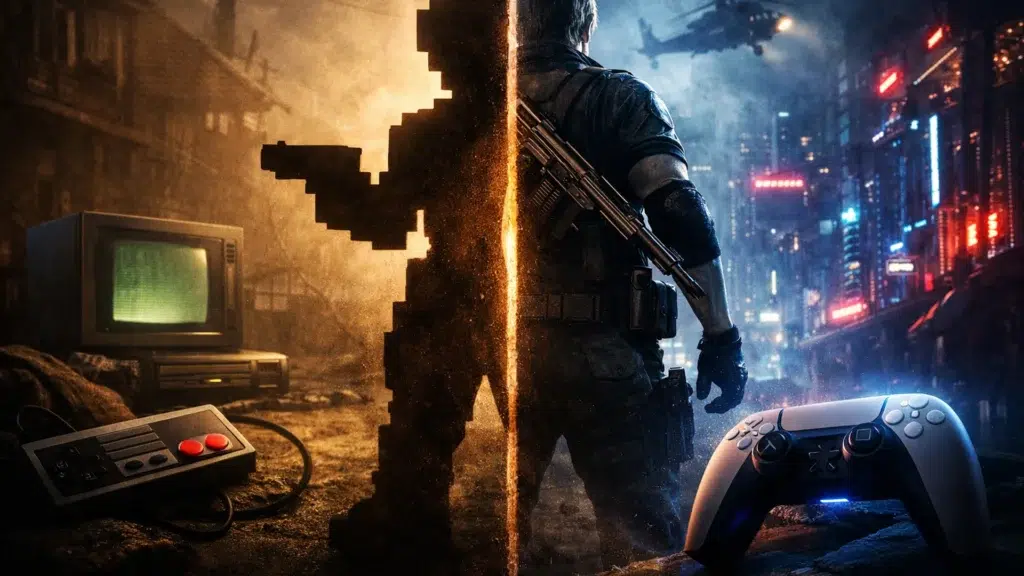
Video Game Remakes: 9 Clear Signs It’s Worth It
I’ve been a gamer since 1984, which means I’ve lived through every version of the same promise.
“This is the definitive edition.”
“This is how it was meant to be played.”
“This time, it’s finally perfect.”
Back then, “perfect” was a moving target you chased with whatever you could afford: a sharper CRT, a sturdier pad, a faster CPU, a sound card that made the music feel like it belonged to your room. Games changed with your hardware, and your hardware changed because games demanded it. You learned to love friction. Loading screens that gave you time to breathe. Difficulty spikes that forced you to respect the design. A rough edge here and there that became part of the memory.
That is why the modern remake era hits differently. It is not just nostalgia anymore. It is craft, risk management, preservation, and sometimes, blunt monetization. Remakes are not a side dish. In the last eight years, they have become one of the industry’s loudest strategies and one of its sharpest artistic opportunities, especially when publishers want a safer bet than a new IP, and players want the comfort of something familiar without the pain of dated controls.
When it works, a remake feels like time travel with the benefit of hindsight. When it fails, it feels like someone rebuilt your childhood home and forgot where the warmth used to sit.
This is the framework I use now. Not as a reviewer chasing hot takes, but as a player with decades of muscle memory, who wants to be fair to the original and honest about what money and time are worth in 2026.
Video Game Remakes are not remasters, and that difference matters
A remaster is usually a promise about fidelity. Higher resolution, cleaner textures, better frame rate, modern platform support. A remake is a promise about intent. It is the same story, the same spine, but rebuilt in a new body.
That is why Video Game Remakes create stronger reactions than remasters. They are allowed to touch the sacred parts: pacing, combat rhythm, animation language, even how a character looks at the camera when they lie. They can fix old mistakes, but they can also erase the rough edges that made the original special.
If you want a quick rule: a good remaster respects your memory. A good remake respects your time.
And the last eight years gave us plenty of proof that the ceiling is high. We got remakes that became new benchmarks for how to modernize play feel and presentation, like Resident Evil 2 (2019) and Resident Evil 4 (2023).
We also saw how complicated the conversation gets when a remake is technically impressive but debated in terms of necessity or pricing, like The Last of Us Part I (2022).
So, how do you judge whether a remake is worth your money?
The 9 clear signs a remake is worth it
1) It modernizes the “feel”, not just the pixels
If the original game’s biggest barrier today is how it feels in your hands, a remake has a real job to do. Camera control, acceleration curves, hit feedback, animation cancel windows, input buffering, aim assist behavior. This is where your money either makes sense or it doesn’t.
Resident Evil 2 (2019) is a great example of a remake that rethinks how you move, aim, and read threat, not just how the world looks.
Resident Evil 4 (2023) does the same in a different way, taking a beloved action template and modernizing its responsiveness while keeping the tension that made the 2005 version iconic.
If the remake trailer screams “graphics”, but previews and hands-on impressions barely mention controls, pacing, or combat readability, that is a warning.
2) It respects pacing, and fixes it where the original aged the worst
I love older games. I also know that some of them were padded because storage, memory, and production realities demanded it. Repetition used to be a feature and a necessity. Today, it is usually just repetition.
A strong remake trims filler, tightens backtracking, and does not confuse “longer” with “better”. It keeps the moments that breathe and removes the moments that stall.
3) It rebuilds lighting, audio, and atmosphere as gameplay systems
In my head, the best Video Game Remakes do not chase realism. They chase clarity.
Modern lighting and audio can be gameplay. It can change how you read a room, how you predict danger, how you interpret distance, and how you feel stress. Dead Space (2023) is a clean case where atmosphere and audiovisual design are not decoration. They are the loop.
If a remake looks expensive but sounds flat, or if its lighting makes enemies harder to read, you are paying for spectacle that fights the game.
4) It adds accessibility as a first-class feature, not a checkbox
This is one of the most important changes in modern gaming, and remakes are the perfect vehicle to retrofit what older classics never had the budget or awareness to build.
The Last of Us Part I (2022) is a strong example of a remake that explicitly emphasizes expanded accessibility options alongside gameplay revisions.
Even if you do not personally use accessibility features, they matter. They widen the audience, they improve usability, and they often make the game feel better for everyone.
5) It proves it understands why the original was loved
This is the emotional core, and it is where veteran players become unforgiving.
A good remake knows which moments are “untouchable” and which moments are simply “old”. It preserves tone and identity, even when it changes mechanics. It can reinterpret presentation without rewriting the soul.
Final Fantasy VII Remake (2020) is a great reminder that a remake can be faithful in spirit while being bold in structure. It does not pretend the world is the same. It tries to make the feeling of that world land again for a new generation.
Final Fantasy VII Rebirth (released on PS5 February 29, 2024) pushes that conversation further, with more scale and more room for the project’s modern identity to breathe.
Not everyone will agree with every reinterpretation, and that is fine. The question is whether the remake’s changes feel intentional, or accidental.
6) It makes smart, honest choices about what to expand and what to leave alone
Expansion is risky. “More content” can mean “more value” or “more dilution”.
The best Video Game Remakes expand with purpose: a stronger supporting character arc, a more coherent quest line, a clearer emotional throughline. The worst remakes expand like a buffet: more, more, more, until nothing tastes distinct.
This is also where you should pay attention to the studio’s language. If everything is described as “bigger” and “more open” without explaining why that serves the original design, be careful.
7) It upgrades the entire ecosystem: performance, stability, modern platforms
A remake that ships with stutter, broken HDR, unstable frame pacing, or inconsistent input latency is not “modernized”. It is just repackaged.
Demon’s Souls (2020) launching as a PlayStation 5 title is a useful reminder of how transformative a full rebuild can be when the target platform is clear and the technical ambition is aligned with it.
Likewise, seeing major remakes hit broader ecosystems over time changes their value proposition. Final Fantasy VII Remake originally released on PS4 in April 2020, and later expanded across platforms with Intergrade and PC versions.
A remake’s worth is not just what it is today. It is what it becomes after patches, platform support, and community feedback settle.
8) It has a fair pricing and upgrade story
This is where players get cynical, fast, and honestly, often for good reason.
If you already own the original, do you get a discount?
If you own a remaster, is there an upgrade path?
Is the “Deluxe” edition mostly fluff?
Is the remake priced like a new AAA release without delivering a new AAA scope?
The Last of Us Part I is a good example of how pricing and perceived necessity can become part of the remake conversation, regardless of technical quality.
Your money is not just paying for nostalgia. It is paying for labor. But labor still needs to justify the price.
9) It earns trust with transparency and post-launch support
Remakes live and die by goodwill. If a studio communicates clearly about what is changing, why it is changing, and what it is not trying to replace, players lean in.
And when a remake gets real post-launch support, it signals that the publisher treats it as a product with a future, not a quick nostalgia harvest.
The red flags: when a remake is just a reskin with a premium price tag
These are the warning signs I take seriously now:
- The marketing focuses almost entirely on “rebuilt visuals” and avoids specifics about controls, pacing, or AI behavior.
- There is no clear explanation of what qualifies it as a remake rather than a remaster.
- Preview coverage is light on hands-on impressions, heavy on cinematic trailers.
- The game feels designed to sell an edition, not deliver a vision.
- Performance issues are framed as “expected” for launch, with vague patch promises.
I’m not saying every launch needs to be perfect. I’m saying a remake has less excuse than a brand-new game. The map is already drawn. The question is whether the studio used the new tools to rebuild something worthy, or just repaint something familiar.
Why Video Game Remakes exploded in the last eight years
Here is the honest truth: remakes are the intersection of art and insurance.
They preserve brands. They reduce narrative risk. They bring older audiences back without needing to convince them from zero. They also let studios show off new engines and pipelines using a known template.
But there is also something more human happening, especially for players like me who started in the 80s.
We are not only buying games. We are buying access to old feelings, updated for modern lives.
In 1984, you could sink an entire weekend into learning a game because your time belonged to you in a different way. In 2026, time is fragmented. The best remakes understand that. They deliver the same emotional punch with less friction and more respect.
And yes, sometimes it is just commercial. But when a remake is done with taste, it becomes preservation. It becomes a bridge. It becomes the version you can recommend to someone younger without adding a disclaimer that begins with “just be patient for the first five hours”.
The personal test I use before I buy
When I’m on the fence, I ask myself three questions:
- If I remove nostalgia completely, does this game still sound like something I would recommend today?
- What exactly is being rebuilt: the experience, or just the asset library?
- Will the remake replace the original in my mind, or will it sit next to it as a different interpretation?
If the answer to question two is “mostly visuals”, I wait for a deep discount. If the answer is “the experience”, I consider day one.
Closing thoughts
Video Game Remakes are not going away. If anything, they are becoming one of the cleanest mirrors we have for how the industry thinks: about risk, about legacy, about preservation, about what it means to modernize without erasing.
As someone who’s been here since 1984, I do not want remakes to stop. I want them to grow up.
I want them to treat classics with the same seriousness we treat new releases. I want them to respect the original without worshipping its limitations. And I want them to remember the simplest truth: a remake is not a museum piece. It is a new invitation.
If you want, drop in the comments: which remake felt like coming home, and which one felt like a stranger wearing a familiar face?
Internal link: If you want more long-form coverage, browse our Reviews section.
For more details, read Capcom’s official Resident Evil 4 remake announcement for a full breakdown and expert analysis.
0 Comments
To keep discussions clean, commenting requires a Noobidio account.