
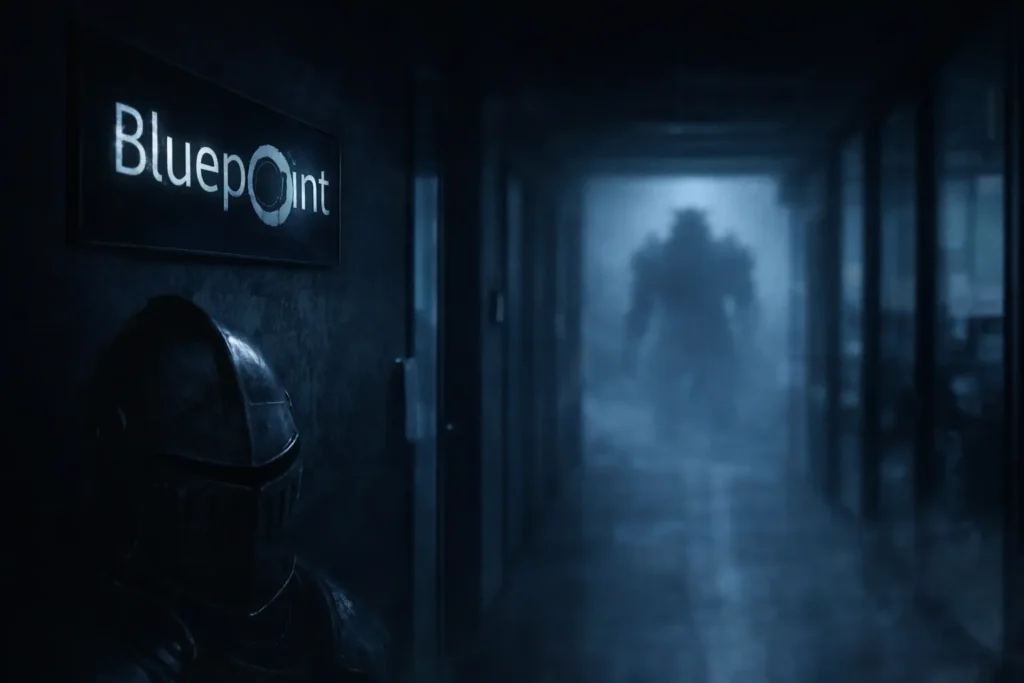
Sony Shuts Down Bluepoint Games – Bluepoint’s Legacy, the Studio-Closure Wave, and What Comes Next
Sony shuts down Bluepoint Games. For many players, that sentence lands like a glitch in reality. Bluepoint wasn’t a studio synonymous with controversy or creative stagnation – it was synonymous with craft. With Demon’s Souls and Shadow of the Colossus, Bluepoint became a quiet benchmark for what “respectful modernization” can look like when a team treats old games as living history, not disposable content.
And yet, in the current era of game development, “critically respected” is not the same thing as “strategically protected”.
This is not just the story of one studio. It’s a lens into what modern AAA is becoming, why the industry has been shedding teams even while revenues remain massive, and what happens when a business model built on growth collides with the reality of production costs, shifting audience habits, and a live-service gold rush that taught publishers the wrong lessons at the wrong time.
What happened to Bluepoint Games?
Sony shuts down Bluepoint Games following a recent business review, with the studio expected to close in March 2026 and an estimated 70 employees impacted (as reported by Bloomberg and echoed across major outlets). Bluepoint was acquired in 2021 and spent its PlayStation Studios years balancing prestige work, support roles, and a reported pivot toward new projects that never reached the finish line.
The immediate headline is simple. The implications are not.
Bluepoint’s story – from “the porting wizards” to prestige remake specialists
Bluepoint’s rise has always been a little unusual. It wasn’t the classic “new IP studio” arc, where a team becomes famous by inventing worlds. Bluepoint became famous by rebuilding worlds – and doing it with enough technical and artistic finesse that the rebuild sometimes became the definitive version.
That reputation didn’t appear overnight. Bluepoint built it the hard way: by doing the less glamorous work exceptionally well.
Early on, the studio was known for high-skill remasters and ports, the kind of projects that live or die on technical execution, performance targets, and the ability to preserve the feel of an original while modernizing pipelines. Over time, that expertise evolved into something rarer – the ability to remake a beloved game in a way that satisfies both preservationists and modern players.
The Bluepoint method: fidelity without fossilization
A great remake is not a graphics patch. It’s translation. You’re translating design assumptions from one era into another: camera language, control expectations, accessibility norms, performance baselines, and player patience.
Bluepoint became elite at that translation because it approached remakes like high-pressure restoration work.
- Preserve the silhouette of the original design.
- Upgrade readability and responsiveness.
- Modernize lighting, animation, and audio without rewriting the game’s identity.
- Remove friction that was never “difficulty” – just outdated interface.
When that balance works, players call it “faithful”. In practice, it’s an enormous creative and technical negotiation.
Demon’s Souls and Shadow of the Colossus – why these remakes mattered
Demon’s Souls: a PS5 statement piece that wasn’t just pretty
Demon’s Souls wasn’t merely a remake of a cult classic. It was a launch-era proof-of-competence for PlayStation 5. It demonstrated what current-gen could do when a team is given time, resources, and a clear goal: rebuild, refine, and keep the soul intact.
It also mattered historically. Demon’s Souls is a foundational pillar of a genre that went from niche to mainstream. Preserving it – and making it playable in modern terms – wasn’t nostalgia. It was cultural continuity.
Shadow of the Colossus: modern tech serving old emotion
Shadow of the Colossus is an all-timer because it’s minimalistic in the exact way modern games rarely dare to be. The remake’s success wasn’t guaranteed: remake the art wrong and you destroy the tone; change the pacing wrong and you break the feeling of isolation.
Bluepoint managed to modernize fidelity while respecting restraint. That’s a harder target than it sounds, because restraint is not “lack of detail” – it’s a design choice you can accidentally overwrite with technical ambition.
The pivot that never fully materialized – and why that matters
For years, players assumed Bluepoint would remain the remake studio. But industry reporting and subsequent discussions around Sony’s broader live-service push painted a more complicated picture. Bluepoint had reportedly been involved in or attached to a live-service God of War project that was later canceled, and also contributed support work (including a role in God of War Ragnarok’s broader development support pipeline, as several reports suggested).
If that’s true, it reframes the closure in a harsh light: the studio famous for a specific kind of excellence was being pulled toward a trend-driven strategy, and when that strategy contracted, the studio did not survive the contraction.
This pattern is not unique to Bluepoint. It’s one of the defining pathologies of the last few years: publishers repositioning teams to chase the “next growth engine,” then cutting those same teams when the engine doesn’t ignite fast enough.
Why are studios closing across the industry – even when games sell?
The studio-closure wave isn’t caused by one thing. It’s a stack of pressures that amplify each other.
1) AAA costs have escaped the gravity of predictability
AAA development has become structurally expensive in ways that aren’t always visible to players. Higher-fidelity assets do not scale linearly. Every extra layer of detail multiplies dependencies: animation complexity, lighting polish, QA surfaces, localization scope, platform certification, and post-launch support expectations.
When budgets swell, risk tolerance drops. When risk tolerance drops, publishers chase “proven” formats – sequels, remakes, live-service – because original bets become harder to justify.
The irony is that this risk-avoidance can produce a riskier portfolio overall, because it converges everyone onto the same strategies.
2) The live-service gold rush distorted planning
Live-service can work, but only under very specific conditions. It demands long-term content cadence, community management, and a value loop that competes with every other game-as-a-habit on the market.
The industry spent years treating live-service like an automatic multiplier, not a separate discipline. The result was predictable: many projects got funded because the category looked profitable, not because the studio was structurally built for it.
When those projects wobble, publishers don’t just cancel games – they cut the teams attached to them.
3) “Growth” expectations stayed, even when the market normalized
The post-2020 surge created expectations that were always going to normalize. When normalization arrived, many companies reacted like it was failure, not reversion. Layoffs and closures became the blunt instrument to make quarterly targets look cleaner.
Tracking estimates across 2022-2025 suggest tens of thousands of roles affected industry-wide. This isn’t a single bad year. It’s a multi-year correction.
4) Consolidation changes the incentives
Acquisitions often promise stability. In practice, they can create a “portfolio mindset” where studios become line items. When priorities shift, what was once a proud identity can become a “capability” to relocate elsewhere.
If a publisher believes it can retain an IP pipeline without retaining the exact studio identity, the studio becomes easier to cut.
The uncomfortable truth – Bluepoint’s closure is a signal, not an exception
In a healthier ecosystem, Bluepoint should be the kind of studio you protect for the long term.
- It preserves legacy titles.
- It strengthens platform history.
- It builds trust with core audiences.
- It can deliver prestige releases that anchor subscription libraries and hardware narratives.
So what does it mean when that studio gets shut down?
It suggests a shift where prestige is not enough. A studio must either:
- Ship tentpole-scale hits at high frequency, or
- Attach itself to “growth” bets that look good on strategy slides, or
- Become so essential to a pipeline that cutting it would break core production.
Bluepoint was prestigious. It may not have been strategically central under the latest internal direction.
That is the modern contradiction: the industry still celebrates craftsmanship publicly while increasingly rewarding scale and growth narratives privately.
Impact on PlayStation – the hole Bluepoint leaves behind
1) A gap in PlayStation’s “heritage pipeline”
PlayStation’s back catalog is one of its strongest assets. Not only for sales, but for brand identity. Bluepoint gave Sony a specialized team that could elevate that catalog to modern standards.
Without Bluepoint, Sony must either:
- outsource remakes/remasters more aggressively,
- assign other internal teams (already busy) to heritage projects, or
- slow down that part of the release strategy.
None of those options is ideal, because remake quality is not guaranteed by budget alone. It’s guaranteed by taste, process, and obsession with details.
2) A chilling effect on “craft-first” studios
When a craft-first studio closes, every other mid-sized team notices. It reinforces a lesson that developers already feel: excellence does not equal safety.
That has downstream consequences:
- talent migration toward “safer” sectors,
- more risk aversion at the studio level,
- less willingness to specialize deeply.
Specialization is a competitive advantage. But it becomes harder to maintain when strategy shifts can erase your value proposition overnight.
3) The messaging problem Sony did not choose, but now owns
Every major publisher is navigating the closure wave. But certain closures cut deeper because of the studio’s reputation. Bluepoint was not perceived as failing.
So the narrative becomes: if Bluepoint can be cut, anyone can.
That’s a morale and recruitment problem. Especially for first-party ecosystems that rely on long-term retention and institutional knowledge.

What the future could look like – three scenarios
Scenario A: Sony recenters on fewer, bigger single-player releases
If Sony’s internal takeaway is “focus on what we do best,” we could see a sharper return to tentpole single-player prestige, with a smaller and more selective live-service footprint.
In this scenario:
- remasters/remakes continue, but via partnerships and outsourcing,
- first-party teams focus on flagship projects,
- platform identity becomes the differentiator again.
Scenario B: Consolidation and central tech groups replace studio identities
Another possibility is structural consolidation: fewer studios, more centralized production services, shared technology, and distributed support teams.
In this scenario:
- the “Bluepoint skillset” gets absorbed, not preserved as a studio identity,
- future remakes may happen, but without the same signature consistency.
Scenario C: The industry resets, but the middle remains fragile
The most likely broad outcome is a slow reset. Costs will be challenged. Timelines will be questioned. Some publishers will stabilize. But the middle tier – the teams that are too big to be indie and too small to be untouchable – will remain vulnerable.
That’s the bracket Bluepoint lived in: elite, respected, but not structurally protected by a flagship IP ownership model.
The larger lesson – modern gaming needs fewer miracles and more sustainability
If you want one sentence to keep from this story, it’s this:
The industry has become too dependent on exceptional outcomes to justify ordinary operations.
When budgets are huge and timelines long, the margin for “just good” disappears. Everything must be a hit, or at least a growth platform. That’s not sustainable for an art form that thrives on variety and experimentation.
Bluepoint’s closure is especially painful because it represents a kind of excellence that’s rare: patience, restraint, and deep technical artistry in service of preservation.
If modern gaming can’t keep a studio like that alive, then the problem isn’t talent. It’s incentives.
And incentives can change – but only if publishers, platforms, and audiences start rewarding long-term value as loudly as they reward launch-week hype.
Closing thought
Sony shuts down Bluepoint Games at a time when the industry is already braced for more closures, more layoffs, and more “strategic resets”. But this one will stick in memory, because Bluepoint’s work wasn’t disposable. It was definition-quality.
Whether PlayStation replaces that capability with outsourcing, absorbs it into other teams, or simply moves away from that kind of project, one thing is clear:
We are watching the industry decide what it values.
And right now, it is not consistently valuing craft.
Source: Sony shuts down Bluepoint Games report and details
More News on Noobidio here
0 Comments
To keep discussions clean, commenting requires a Noobidio account.